Sunday, 13 April 2014

Riding in Tuscany

Every other year my place of employ offers its clients the opportunity to travel abroad. For every six clients who take up the offer, requires one staff member to chaperone the group on the journey. This year was a travel year, Italy was the destination, and I was one of the chaperones. (This was my second time to Italy, the first trip being in 2009.) As the itinerary sort itself out for this trip it appeared that there would be a morning into early afternoon window while we were staying near Florence. I began to dream. I began to seek bike rental shops. I began to look at maps.

As often is the case with the best laid plans, they don't often reach their potential until the last moments. The major hurdle was to find a bike in Florence or near the hotel. This might seem a completely reasonable task, given that Italians are know to be somewhat mad about biking. For me however bridging the language barrier and securing a quality road bike for a specific date and time proved to be a bit of a challenge. I'm sure it's the case that not every little bike shop in Italy is online. Fortunately for me florencebybike.it was online and they took my late registration for a full carbon bike. Here's the shop, at 54r Via San Zanobi, just four blocks from the Duomo!


Between email and a linguistically generous phone call or two, I ended up with this full-carbon Williers (46 Es for the day),


and this map (actually three: one to get me out of the city, one to get me to Impruneta, and one for the rest)!


The route as described by the super helpful and friendly staff of Florence By Bike should have been 77 kms, but I managed to detour, get lost, get help, get lost again, get help, get lost again, get more help, get lost once more, and get still more help from patient, friendly Italians, and stretch the ride to 85 kms.

The weather was good, 14'C and overcast. The riding was fantastic, rolling hills, some climbs as long as 5 kms and as steep as 10%, and orchards and vinyards all around. My pics aren't great, but here they are anyway. 


At 2:30 pm I road in to Piazza de le Signoria, sat down at the Cavalinio restaurant, ordered a Peroni and a Margarita pizza and thought, what a lucky boy am I!


Sunday, 16 March 2014

How about a 29er? Don't mind if I do.

After riding the Epica with four guys on 29ers I imagined that I was witnessing what all the fuss was about. I imagined that those bigger wheels, bigger everything, made riding the snow easier for them, which must have been why I had to work so hard to keep up (and upright) on my 26" (There were of course other, more significant reasons, but I needed a scapegoat). And having ruled out the other craze these dayz - the fatbike (just too one-ish dimensional for me) - I began dreaming. In fact I dreamed so hard, it came true, this week:
It's a 2013 Jamis Dragon Sport
I was determined that the frame would be steel, and that the bike would be purchased in whole or in part from the LBS. That and I wanted to order the parts and build it myself. Initially I was looking at the Karate Monkey frame, but the LBS couldn't bring that frame in. Bruce gave me a few options, one of which was that he'd bring in a Jamis Dragon Sport, strip it, and sell me the frame, which was pretty good of him, except that the price he quoted for the whole bike made it clear that I'd be spending a bunch more cash for about the same or lower quality components to build it myself.

Shimano hydraulic disc brakes, Deore, & reasonable Alex wheels
RockShox XC 32 and Ritchey cockpit: 90 mm stem & 725 mm bar
The steel is Reynolds 520, so the bike's not super light, but all this comes to me for a few bucks over a grand, before taxes. I added eggbeaters, a long Easton seatpost, and a fizik saddle to make things fit for me. I think it looks and feels pretty good. 

Today, in a March snowstorm (winds 30 to 50 km/h) I took it for a ride. Oh my. There were lots of drifts across the roads, and under that ice and ruts. This bike handles so well! The front wheel hardly deflects at all in snow, and it rolls over iced snow banks and ruts with the kind of certainty that really surprised me. I did not expect it to be so much different from the 26" bike, or from my 700c winter commuter (a cross bike). It just rolls over things. 

I did some reading today about bar width. I was thinking that I'd cut them down. After all, 29" wide bars for me (at just under 5'7") seemed ridiculous. But the online consensus was that wider meant more stable steering, and more control of the wheel's line. So I decided to ride it first, and I'm convinced. I will not cut them down. Between the big wheels and the wide bars you really feel confident. You feel large and in charge. 

Speaking of working on being large and in charge ... this kid did some fine riding this weekend at the Tucson Bicycling Challenge.


She's been upgraded to Cat 2, so she rides with Cat 1 and Pro riders. The field was pretty tough at this 3 stage event. On Friday she puked beets and other weird shit during the TT but still managed a 18th place finish. On Saturday she felt a bit better and raced to 13th in the road race. Today, she road the circuit race (a six mile loop - an extended criterium) and placed 7th, for a GC finish of 14th. Yeah. I'm proud. As of this May she will have been racing road for one year. She's doing okay.

Sunday, 9 March 2014

Various vicarious things

It's been three weeks since the Epica and I'm still awfully fond of the memories. So fond that I remain convinced about doing it again next year. So convinced that I can do things differently that I've ordered a steel hardtail 29er (which is in the LBS just now, but I'm so taken up with the school theatre production that I won't have time to pick it up and put it together until the week after next (report and pics will be posted) ... which is another story about what could possibly be so demanding that I won't have time to pick up the new bike I've pining for ... which is a story about me and priorities ... which is about habits of mind that are hard to break). In the meantime I've returned to commuting with my crossbike commuter, a set-up that I'm convinced is best for commuting in all weather in and in all terrains. (If you regularly need a fatbike to commute, you're probably living somewhere North of 60'.)

Canadians training in California (l-r): Jason Wiebe, Karlee Gendron, Danick Vandale, GeeVs, Chris Prendergast. (pic by Jayson Gillespie)

On the vicarious front GeeVs has begun her racing season in the southern states. After training for about a month in California, in Oxnard just north of LA, she now lives with a teammate in Tucson, Arizona. Her first race was the Valley of Fire stage race, last weekend in Overton, Nevada. She raced in the Cat 1/2/3 Pro category, as a Cat 3 rider and placed 7th in the Time Trial, 24th in the Crit (she was ridden off the course by another rider and lost the main pack), and 5th in the Road Race (sprint finish with same time for places 2 through 7) for 9th place in the GC. Pretty good considering there were US pro cycling team members in the field.

Yesterday she road the Old Pueblo Grand Prix criterium in the Cat 1/2/3 Pro race (the only women's race). This race is a pretty big deal, since several pro teams compete: Optum, Vanderkitten, Colavita. GeeVs rode on her own, wearing the Manitoba colours, and placed 21st out of 36, a result that made her very happy. She was fully prepared to have her ass handed to her, but she felt strong and able to manage the pace of a 50 minute race averaging 38 km/h over a technical 6-corner course, all while racing without teammates.

Road racing on a bike is not a solo sport at the upper categories. If you consider that teams like Optum, et. al. have six or seven riders each in the field who all work together to pull their best rider into the best position to sprint to win at the finish (for example, Optum's Canadian Leah Kirchmann placed 3rd in this year's race - a race she won last year), riding alone in that pack could be daunting, but GeeVs stayed with them and learned a lot about racing in a pro peloton. And GeeVs does not consider Criterium-racing her strength - she's more likely to have success in the road-race and time-trial disciplines.

The end of all this is that GeeVs license has been upgraded from Cat 3 to Cat 2, which is exciting, especially after only 10 months of bike racing experience! Proud PauPs? Yes. Indeed.

Monday, 17 February 2014

Actif Epica - Report 1 - The basics

I finished, in about 13 hours, and about 13th place. This is me coming in at The Forks, getting hugs from Bekah and Sara.


There was (and still is) a lot of snow out there, and the wind came in steady from the North at between 20 and 30 km/h for the whole day.

It was hard and I learned a lot about several things, most of which had to do with riding a bike in winter for more than 12 hours. This was not a commute.

Thanks so much to the organizers and volunteers and to Graham, Kevin, Luke, Mark (and at the end Svetlana) for riding along with me. My dogged inner spirit needed other dogs to keep me going at a few points.

Shortly I will say more about this, I'm just going to take enough time to say it with care (and hopefully with a few more photos).

Sunday, 9 February 2014

Epica Prep 2 (and final, besides commutes of course ...)

It was colder today than last weekend (-25 ish with a 26 km NW wind for a windchill in the high -30s), so naturally I decided I'd go farther. Well, not naturally. Not naturally at all. I just considered that it would be a good test of equipment, and me. Mostly me. I'm excited about the race, but there are always doubts to contend with. It's better to put your head down and dig in a la Boxer: "I will work harder. [Suffering] is always right." Which was, in fact, half of a two-pronged meditation delivered at church today (glory be I attended church for the first time in about two months and the message fits) in which the pastor quoted Richard Rohr who says, reasonably I think, that there are two ways available to all human being to experience "transformational change" (all right, I admit, that that term right there leaves hanging the question, "change for better or for worse?" and I'm thinking Rohr was thinking "for better" but there's no way of guaranteeing that sort of thing), through great love, or through great suffering. Which begs the question, "If you bring 'great suffering' on yourself, does it count?" Of course I'm inclined to say ... it depends. But it is possible. I believe it. It's my religion. It must be. It's the thing I'm most consistent at in my spiritual endeavours, I bring suffering on myself. At least that's the way I see it, from way over here in "first-world-problem-land." At the end of the ride, I looked like this:


Anyway, it was cold and windy, and I worked harder. I rode 16 miles. For four of those miles I followed dirt roads that are not used in winter (intermittent, and often significant drifting - "sculpted," as Ian so eloquently put it), and for two of those miles I rode the Trans-Canada Trail, which the snowmobilers around here seem to think is fair game for them, despite the signs (just proving that people who sit on their asses and move themselves around by twitching a thumb are indeed illiterate asshats). From this I learned that it's better to ride on snow drifted in and hardened by the wind then it is to follow a snowmobile track, which may or may not hold you and your bike up. The remaining miles were on gravel, with a one mile or so reprieve of pavement and paved trails in town (A-town).

Which brings me to what I learned today.
The bike which looks like this,


works, though I would like to do a parallel ride with a fat bike, just to see. Adjustments from last week's ride are: added bar tape to my "aero" bars (bar-ends that I installed on the centre of the bar, to give me a few options for riding position); strapped and bungied my pannier on top of my seatpost (because it's bigger than most rackbags and seatpost bags, and because it works - for me), and removed the traps on the pedals (which impacts my pedalling efficiency, but makes remounting and starting in the middle of snowpack way easier). By Saturday I'll have added a handlebar bag for a bit more storage - likely for food, and somehow strapped my cue sheep/map bag (Sealline) to the front bars ... somehow.

My face and eyes worked today. What I mean is, I tried petroleum jelly on my face (as a wind barrier) rather than a neoprene mask, which made the goggles stay frost free waaaaaay longer. Although there was some frost on them, and if I was going to try to read the cue sheet I'd have to lift them up, I could use them for the whole ride today. Nice. And it seems, as I write this now, that my cheeks and nose have not been frost-bitten. I did not believe that petroleum jelly would work. Now I believe. Yet another small conversion for this small doubting believer.

My feet were warmer, but not entirely. I was wearing my Sorels, with new inserts, but I needed to stop when I did. It took about 15 minutes after I stopped for them to be right. It was a longer and colder ride, so I'm finding some comfort in that, but now I'm thinking about buying some plastic pedals to reduce the cold transfer. It can't hurt.

The water situation is solved. I bought a 2L Platypus bag (on sale at MEC) and put it into an old "Mountain Gear" camelback knockoff bag (from MCC). I put it on top of my base layer, and then put a thin fleece and wind layer over top, and ran the waterline up my sleeve and clipped it at my wrist. Just over half-way into the ride the waterline worked. It actually seemed warm. I also bought a line insulator for it, but I didn't use it today, and I don't think I'll need too. This set-up was less intrusive than I anticipated. I hardly noticed it at all. Win.

Food. I didn't bring any along, which was a mistake, because I'm going to stop halfway through most of the legs on Saturday and eat something, because, well, food, it does a body good. During the week though I threw a variety of bars, etc, into the freezer to see how hard things would get. My results have led me to decide on using dried figs (still pliant when frozen), Oskri fig bars, and Larabars (though I don't really like them). Each of these are dense with sugars, and stay pliable in the cold. I'm interested in other ideas too, but this is what I've got so far.

Baselayer. I bought a merino wool base layer, and it does keep you feeling warm, even when it's wet, but it doesn't solve the sweaty-wetness problem. I'm scared shitless about how wet I was after this ride. I'm going to bring along numerous dry base-layers to change into, along the way. I'll keep the merino wool on, even when it's wet, but I'll add a dry layer overtop of that, hoping that it will wick up some of the wet and help to keep the chill and shiver out.

Looking forward I love it that the race route has so many turns and changes, and that there aren't many long stretches on one road or trail. The mental distraction of navigating, and changing terrain, will help with managing the discomforts.

Here we go!

Saturday, 1 February 2014

Epica prep report

The Actif Epica is a 130 km ride/race from St. Malo to Winnipeg, via dirt roads, gravel roads, and the Crow Wing Trail. It happens on Feb 15, in two weeks. I've signed up. The course map indicates five check-stops with "stages" varying in distance from 12 to 30 kms. Today I rode 12 miles (19.2 kms) to see what that might be like. I rode a circuit of 9 miles of dirt roads that are not cleared, with three miles of gravel all-weather roads. It was -18'C and the wind was about 13 kms from the NW. I rode North first, for 4 miles, West for 1 mile, South for 5 miles, and so on. There were a lot of drifts.

 Here's what I learned:

The bike
I commute to and from work (16 kms round trip) all winter, so I have an idea of what I'm in for. But I'm not going to use the cross bike a commute on for this race. On the advice of a racer from last year's race, who did use a cross bike, I've decided to ride a 26" mountain bike (no cash just now for a fat bike and, though I'm sorely tempted by them, I'm not certain yet), on which I have put the fattest tires I could find (2.65 inch downhills). They worked pretty well today. I had to get off three times, but for the most part I could ride over the drifts or follow the tracks of a whatever truck or tractor or snowmobile had gone before. I'm happy with the bike decision, though I'll have to adjust the set-up to get the right riding position. It's too upright for me. 

Shifting
You have to be patient, and anticipatory, when you shift. Even when it's only -18'C, the shifter and derailleur are pretty slow to "click" into place. I've got some aerosol de-icer I'm going to spritz into the levers to de-grease them. 

Goggles
I sweat. Even without a face mask, my goggles were frosting up at 4 miles. I didn't treat them with dish soap (which I definitely will), but I'm guessing it will be unlikely that I'll be able to use them for a full 20 kms. Either I'm going to have to slow down, and not generate as much heat, or I'll fog up. 

Sweat
Damn. I just sweat too much, and I have this lie I tell myself, that if I'm not sweating I'm not working hard enough. It's a pain in the ass, really. And it's really not great for this race. I wore three layers today: a lightweight hooded polypro baselayer, a lightweight zipped fleece, and a uninsulated windbreaker. I was not cold, ever. By the end of this 20 kms the base layer was completely wet, and my thin skullcap and the baselayer hood were fused, by ice, to my sideburns (shave them off?) and it hurt to remove them (1st world problem).

Boots
I was sure that my ankle high winter-rated Columbias would be enough, if I wore good merino wool socks. This has just proven not to be the case. I believe it'll be Sorels for me. I'll take the straps off the traps, and still use the plastic pieces to help stabilize my feet on the pedals.

Gloves
Awesome. Thank you Farm Service for your super leather-palmed, unbranded, work mitts. No problems there.

Legs
Two layers was enough. Bike shorts (obviously), a mid-weight base layer, and then a wind-barrier front overlayer (also tights) was just fine. Not hot, not cool. I may put something over my left knee, which has some sensitivity issues due to a past injury. 

All in all, I'd be fine with race day being a day like today. If I had a picture of the roads it'd look like snow drifts over a dirt road, and sometimes, just snow drifts, and no road. Good times ... sorta.

Monday, 6 January 2014

A pleasant holiday; a cold return

This year's winter break has been, well, wintry. As a clan we began by travelling to Canmore for five days of skiing. The weather never got colder than -10'C, and got as warm as 3'C. I spent four days skiing at the Nordic Centre and one day at Peter Lougheed Provincial Park. Four of those days were with fellow clan members, and one was solo, while the others took in the thrills and spills of Mt. Norquay.

(I have decided not to ski downhill. Maybe not ever again, but I certainly have lost my appetite for what used to give me thrills. Now I'm happy to avoid lifts and lift lines and lift tickets and equipment with weight like a stone to help gravity slam your ass down the slope. I dropped the kids and spouse off at the hill and headed back for the Nordic Centre.)

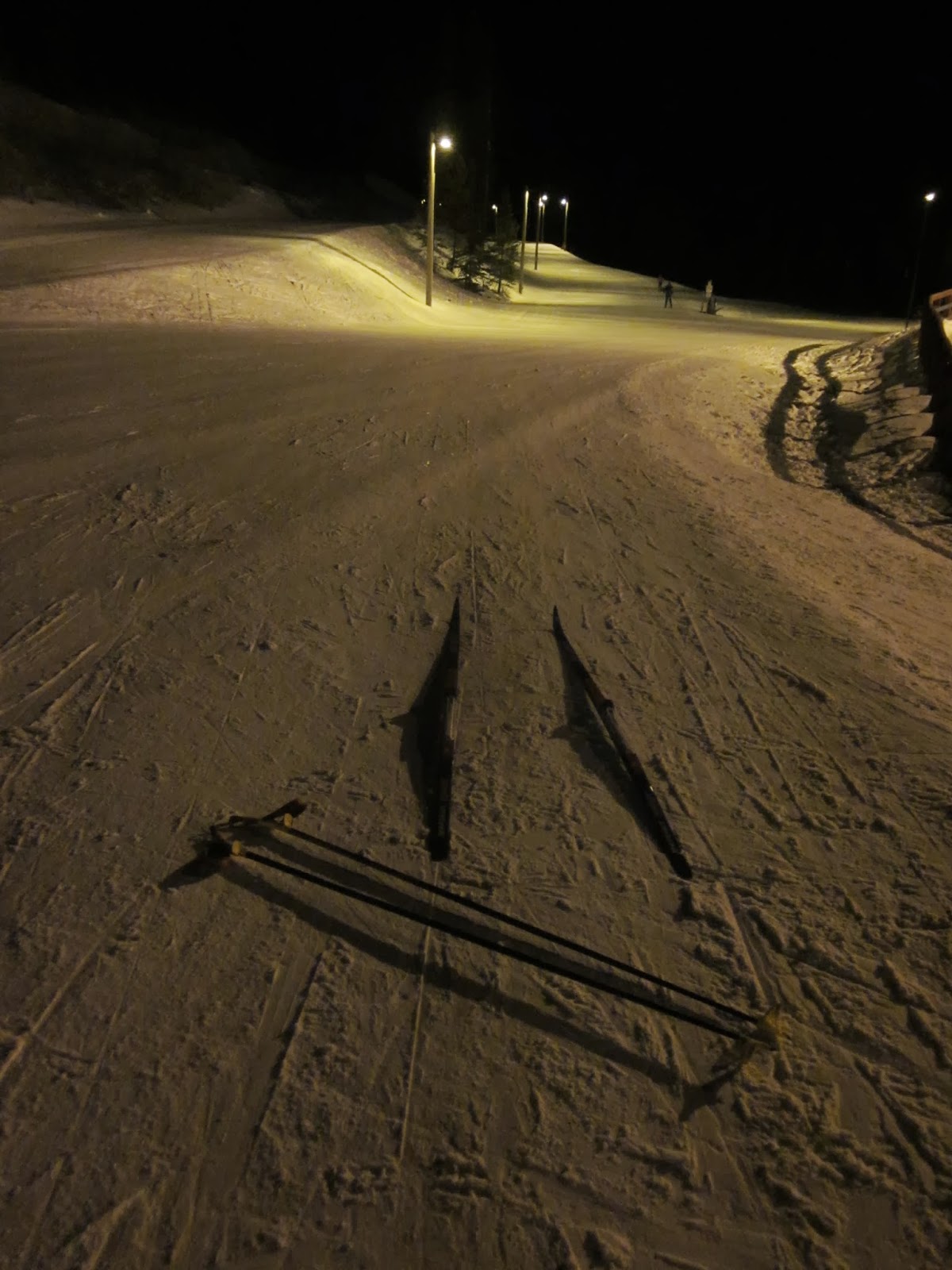
The Nordic Centre was in fine condition, and two night skis were the highlight. They light 6.5 kms of tracks and keep the lights on until 10 pm. While there's a $10 charge per skier for day use, at night you ski for free. Sweet!


The day at Peter Lougheed began climbing for 4.5 kms up the well-tracked WhiskyJack Trail, and then skiing a long way back down following a series of untracked trails that, after about 16 kms take you back to the parking lot. A total of more than 20 kms. Beautiful.

Up the WhiskyJack


Obligatory family photo at the "top"

Tall tall trees and fairytale snow

A detour resulting from the summer flood

This, my friends, is proper, sensible winter out-of-doors activity, in Alberta winter weather. The return home reminded us that we were Manitobans, and winter weather has its variations. Which is not to say that Alberta doesn't get cold. It's just that Manitoba always does. It may be a little earlier this year, but let's face it, we knew it was coming. Why are we so surprised? I don't know, but after skiing in -2'C, I couldn't bring myself to squeak and lurch my way around the trails here, at -25'C. (I still haven't skied here this season.) 

Which brings me to riding in the cold. I commute by bike all year 'round. I have done so for twenty-two of twenty-four years of my working career. Currently my commute is a reasonable, eight km one way, gravel (6.5 kms) and road (1.5) ride. Every year there are a few cold rides. By cold I mean -30'C or colder. Today was one of those days: -36'C, -46'C windchill (whatever that means); the wind came from the WNW at 20 kms, and to get to work I rode into it. It took me just over thirty minutes to get to work today.

At work, after the ride, I looked like this.

I'm a slow learner, perhaps because of an unhealthy tolerance for "getting by on something that works ... sort of". My goggles usually fogging up by the end of the ride. I sweat a lot. By the time I get to work I'm wet and hot (except for the extremities: fingertips, toe-ends, and one other member). I'm trying to figure out how to juggle the heat and moisture I'm generating with the need to keep the wind and cold out. Generally on an 8 km ride, it's not much of a concern, but I've registered for the Actif Epica, so I need to figure out how to ride at a steady pace for a long time, and not heat up (and sweat) over much, but stay just warm enough that I don't slowly frost up into a block of ice. It's a delicate, and vital, balance.

That, and I need to manage the goggle fog thing. BP at my lbs suggested dish-soap on the goggle lens. I tried it today with some success. On the way too work, when it was really cold, there was much much less fogging (icing actually) than usual. At the end of the day, on the way back, it was clear that the lens needed a second treatment. So it's a solution, but a high maintenance one. Maybe that's just the way it is on a bike at -30'C.